HR Glossary
An HR glossary is a concise reference guide defining key human resources terms, concepts, and processes covering everything from recruitment, employee engagement, payroll, benefits, compliance, and workplace culture. It helps HR professionals and employees quickly understand essential terminology in human resources.
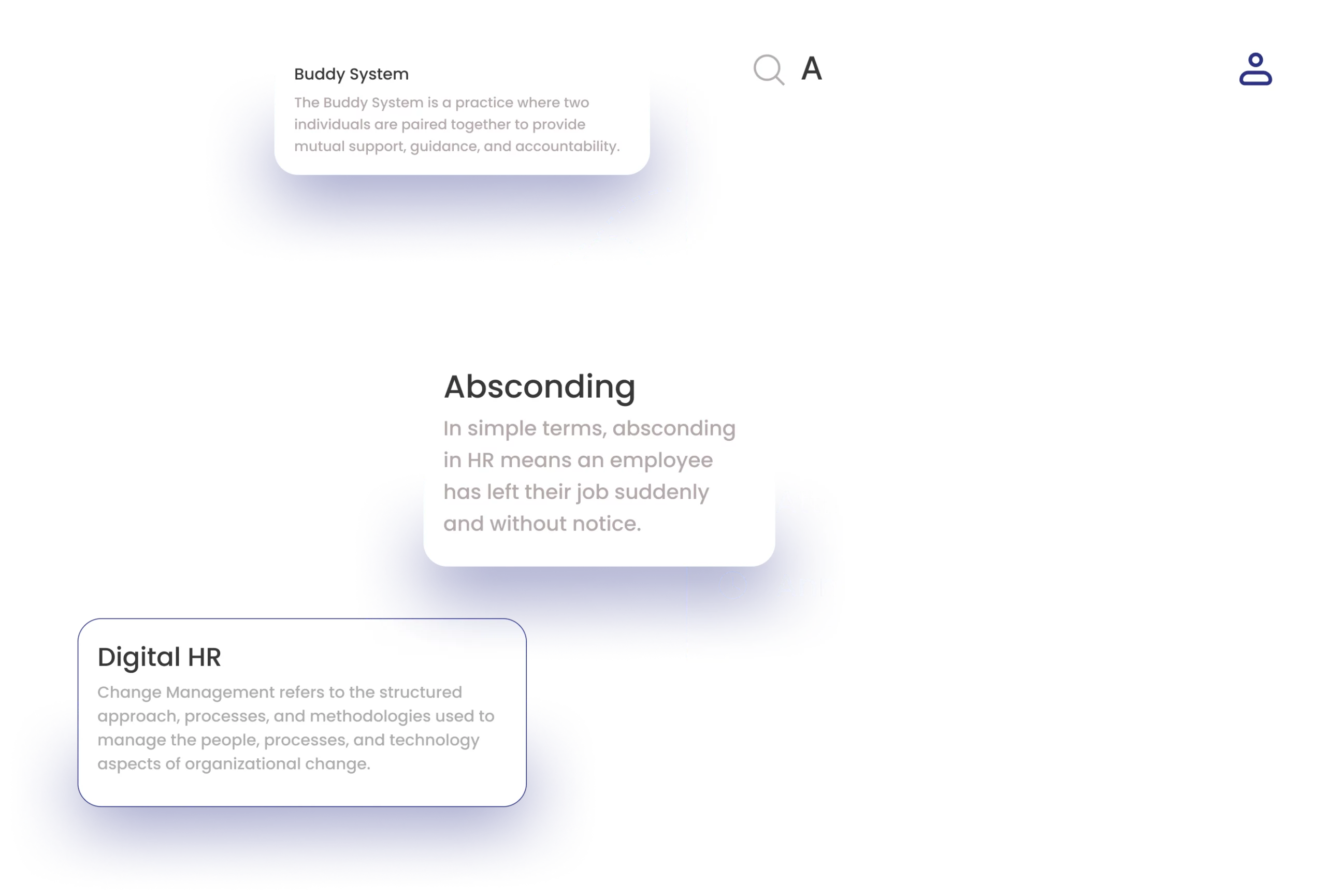
When an employee stops reporting to work for consecutive days without informing managers or peers about the reason or whereabouts; many HR policies define this as job abandonment.
Absenteeism is the habitual or frequent absence from work without valid reasons, often affecting productivity and team performance.
Background Verification is the process of checking and validating a candidate's personal, educational, and professional details to ensure they are accurate and trustworthy before hiring.
Basic salary is the fixed salary an employee gets before employers add bonuses, allowances, incentives, reimbursements, overtime, etc.
The organised framework an organisation uses to reward employees with additional compensation beyond their regular salary. It outlines when bonuses are paid, who qualifies, how bonus amounts are calculated, and the criteria employees must meet to receive them.
A career break is a planned period of time away from work, taken to focus on personal growth, education, family, health, or other life priorities. It usually lasts from a few months to a couple of years and is different from unemployment as it is intentional and purposeful.
Career Pathing is a structured approach that helps employees to see what they can do to make their way in a company based on their skills, interests, performance, and career goals.
Change management is a structured approach that helps organizations plan, implement, and support transitions in processes, technologies, or organizational structures to achieve successful and sustainable outcomes. It focuses on guiding employees through change, minimizing resistance, and maintaining productivity during transitions.
Digital HR is the use of digital technologies, such as AI, cloud platforms, automation, and data analytics, to transform and optimize human resources processes. It enhances efficiency, improves employee experience, supports data-driven decision-making, and aligns HR functions with overall business strategy.
Diversity, Equity, and Inclusion (DEI) is a people-first workplace framework that can help create an atmosphere where all people can contribute, grow and succeed.
Dual Employment refers to a situation where an individual is simultaneously employed by two different organizations, often requiring disclosure and compliance with legal and contractual obligations.
The ability to recognize, understand, manage, and respond to your own emotions while also understanding the emotions of others. It enables individuals to make thoughtful decisions, communicate effectively, build meaningful relationships, and handle difficult situations without allowing emotions to take over.
Employer Branding is the strategic process of building and promoting an organisation's reputation as an employer.
ESOPs (Employee Stock Option Plans) are programs that give employees the option to buy company shares at a set price after a certain time. They help employees become part-owners of the company, motivating them to contribute to its success.
Facilitative Leadership is a leadership style that emphasizes collaboration, shared responsibility, and active participation among team members.
The Five Factor Model (OCEAN) is a framework that describes human personality using five traits: Openness, Conscientiousness, Extraversion, Agreeableness, and Neuroticism.
The Gender Pay Gap is the difference in average earnings between men and women, often caused by inequality in roles, opportunities, and career progression.
Generation Z refers to people born between the mid-1990s and early 2010s, known for being digital natives, socially aware, and entrepreneurial.
High-potential employees are those who are capable of growing beyond the current job and taking on leadership roles.
HR Analytics refers to the use of data-driven methods to understand, improve, and optimize human resources practices and workforce performance.
Incentive Pay is a form of variable compensation paid to employees in addition to their fixed salary, designed performance, productivity, results,
Inclusive hiring refers to recruitment practices that aim to attract, hire, and retain a diverse workforce by ensuring equal opportunities for candidates from all backgrounds.
A compensation and job classification system that groups positions with similar levels of responsibility, required skills, and organisational value into predefined salary bands.
Job enrichment is an HR and management practice designed to enhance employee motivation, satisfaction, and performance by increasing the depth, responsibility, and autonomy of a job.
Key Performance Indicators, commonly known as KPIs,are measurable indicate how effectively an individual, team, or organisation is achieving specific business objectives. KPIs translate goals
Key talent refers to employees who are critical to an organization's success due to their skills, expertise, leadership potential, or strategic contributions. These individuals often occupy roles that significantly influence business performance, innovation, and competitive advantage.
Lateral Hiring refers to recruiting experienced professionals from outside of an organisation for positions that are generally at the same level of seniority as their current positions.
A Learning Experience Platform (LXP) is a modern, learner-centric digital platform that provides employees with personalized learning experiences to develop skills, knowledge, and career growth.
Discover how Managerial Effectiveness improves leadership, employee engagement, productivity, decision-making, retention, and sustainable organisational growth in modern workplaces.
Manpower Optimization is the strategic process of efficiently allocating and managing workforcec resources to maximize productivity, reduce costs, and meet business objectives.
New hire turnover refers to the phenomenon where employees leave an organization shortly after being hired, usually within their first year of employment.
A legally binding agreement that stipulates that one or more of the parties should not disclose confidential, proprietary, or commercially sensitive information to unauthorised parties or entities during or after the business relationship or professional relationship.
Performance management and goal-setting methods for organizations to define strategic objectives and measure progress through quantifiable key results.
Offer Dropout occurs when candidates accept jobs but do not join, affecting hiring costs, workforce planning, productivity, and recruitment efficiency.
Payroll Compliance helps organisations ensure accurate salaries, statutory deductions, tax adherence, timely filings, and legally compliant payroll operations in India.
A formal process through which an organisation assesses an employee's job performance, competencies, achievements, behaviours, and development needs over a defined period.
Workplace harassment is any unwelcome conduct directed at an employee that makes them feel threatened, unwelcome, humiliated or offensive.
Quick Exit Interviews help organisations capture honest employee feedback, identify workplace concerns, improve retention strategies, and strengthen the overall offboarding experience.
Rewards and Recognition (R&R) is a system where employees' efforts and achievements are acknowledged through tangible rewards and sincere appreciation.
The structured process of equipping employees with new knowledge, competencies, and practical skills that enable them to perform a different job or function within an organisation.
Skill mapping is the process of identifying and assessing employee skills to understand strengths, spot gaps, and align capabilities with organizational goals for better workforce planning.
The strategic process of assessing current workforce capabilities, identifying future skill requirements, analysing external talent markets and developing plans to acquire, develop and retain talent that aligns with organisational goals.
TAT, or Turnaround Time, is the total time taken to complete a process from start to finish. It's a vital metric used in industries like IT, customer service, and logistics to measure efficiency and track how quickly tasks or issues are resolved
Union Relations promotes fair negotiations, employee representation, legal compliance, dispute resolution, workplace stability, and productive employer-union partnerships across organisations.
Upskilling is the process of enhancing employees's existing skills or learning new ones to improve performance and stay relevant in evolving roles.
Variable compensation is the portion of pay linked to performance, results, or achievements, such as bonuses, incentives, and commissions.
A complete guide to Virtual Onboarding, covering its process, benefits, challenges, technologies, best practices, and employee experience in remote workplaces.
Work from Anywhere (WFA) is a flexible model that lets employees work remotely from any location, beyond the office or home.
The systematic collection, analysis, and interpretation of employee and organisational data that can be used to improve workforce planning, talent management, productivity, employee experience, and business performance.
Year-to-date earnings are the total amount of an employee’s earnings from the beginning of the current calendar year or financial year up to the present payroll period.
Yield Management in HR is the process of assessing how well candidates progress from one recruitment stage to the next.
Zeal Culture embodies passionate enthusiasm, dedication, and continuous learning, fostering innovation and collaboration for a thriving workplace environment.
A financial planning approach in which every department starts each budgeting period with zero allocation, requiring managers to justify every expense before resources are approved based on strategic business needs.
No matching term found. Check spelling or try another HR term.