
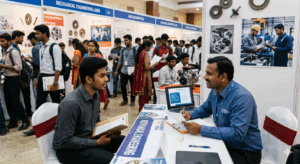
India’s manufacturing narrative has shifted quickly. From electric vehicles debuting in Pune to new renewable energy parks popping across Gujarat, mechanical engineering has moved beyond the numbers of nuts, bolts, and blueprints. It is at the crossroads of automation, AI, sustainability, and cutting-edge manufacturing in 2026.
For employers, one way to see this is this: a mechanical engineer today looks sharper than ever. For professionals, it means a change or a departure. We offer engineering hiring through SheWork, where we also partner with large enterprises, GCCs, and high-growth start-ups across engineering disciplines.
What we have seen so far is simple: mechanical engineer hiring in 2026 is shifting around to the demands of Industry 4.0 and India’s manufacturing renaissance. Let’s decipher what this means for employers and engineers.
The Transformation:
Traditional versus Technologised Engineering
Mechanical engineering has been, and will remain, in many respects a discipline-specific field. You studied mechanics, thermodynamics, materials science and built your career from there. That model is changing in 2026. “T-shaped engineers” are increasingly being hired by companies. What does that mean? Solid knowledge of fundamental mechanical concepts. Broad knowledge of software, automation, data and digital tools.
A contemporary mechanical engineer might design a part in SolidWorks, simulate stress patterns in ANSYS, write Python scripts for analysis, and collaborate with an AI team to optimise predictive maintenance systems. This change is powered by five seismic trends shaping India’s mechanical engineer hiring environment.
Trends in Mechanical Engineering Recruitment for 2026.
Integration of AI and Automation
Factories are getting smarter. Manufacturing floors now feature robotic arms, automated inspection systems, Internet of Things sensors, and AI-based predictive maintenance. Mechanical engineers will work with programming engineers, data scientists, and electronics engineers. What it calls for in recruiting:
Preference for engineers competent in interdisciplinary teams. Knowledge of PLC programming, robotics and automation tool programming. Roles gaining strong demand:
Robotics Engineer. Automation Specialist. AI-enabled Production Manager. These hybrid skill sets are mission-critical for Indian companies looking to make investments in Industry 4.0 upgrades, not optional.
Green Energy and Sustainability Surge
India’s net-zero ambitions and emphasis on renewable energy are influencing hiring. From wind farms in Tamil Nadu and solar panels in Rajasthan to solar power plants, mechanical engineers are at the heart of designing and building power-efficient machines. The electric vehicle (EV) ecosystem is another major driver—from battery systems and thermal management to lightweight materials that require mechanical expertise.
High-growth areas:
- The next generation of EV battery and powertrain systems.
- Sustainable HVAC systems.
- Design of Renewable Energy Equipment.
- Manufacturing processes that use energy in an energy-efficient manner.
Candidates are getting priority for employers who know about:
- Energy audits.
- Principles of sustainable design.
- Thermal optimisation.
- Lifecycle cost analysis.
Mechanical engineering has become closely tied to climate action as a whole, and the field of mechanical engineer hiring is the latest reflection of that fact.
Additive Manufacturing and Digital Twins
A major 2026 transformation is how product design and testing are conducted. Digital twins − virtual replicas of physical systems − make it possible for companies to model performance prior to production.
3D Printing (Additive manufacturing) to drastically shorten development cycles.
This emphasises how mechanical engineers should be comfortable working in simulation-driven environments. In-demand expertise:
- DfAM — design for additive manufacturing.
- Advanced CAE simulations.
- Rapid prototyping.
- Lightweight material engineering.
For Indian startups pursuing aerospace and defence manufacturing, these skills are invaluable. Development cycles are shorter than previously. Expectations for precision are also higher. Simulation knowledge is now non-negotiable.
Hiring by Skills rather than Degrees
That’s a sea change for 2026 as of now. Employers are getting more and more discriminating in their assessments of:
- Project portfolios.
- Hands-on experience.
- Software proficiency.
- Problem-solving capabilities.
Not just looking at a résumé; hiring managers are now evaluating practical experience: GitHub projects, industry exposure, internship exposure, prototype builds, simulation case studies. For mechanical engineers today, demonstrating applied experience has never been more important.
India’s Manufacturing Renaissance.
The Production-Linked Incentive (PLI) schemes and the domestic manufacturing push are both fueling a wave in hiring. Key sectors expanding rapidly:
- Automotive (especially EV).
- Electronics manufacturing.
- Aerospace and defence.
- Industrial equipment.
- Heavy engineering.
Mechanical hiring growth leads cities:
- Pune.
- Chennai.
- Bengaluru.
- Gujarat manufacturing clusters.
The development of new industrial zones in East India. Mechanical engineering forms the centre of India’s industrial growth, and businesses are racing for talent.
Leading Mechanical Engineering Jobs Available for Mechanical Engineering
Well, let’s look at the most desirable positions.
Mechatronics Engineer
Look for an ideal model of a T-shaped professional. Engineering in Mechatronics combines mechanical, electrical, and software systems with machine-based systems. They create automated systems, robots and smart machinery.
Skills required:
- Embedded systems basics.
- Sensors and actuators.
- Programming fundamentals.
- Control systems.
The automotive and smart manufacturing industries, in particular, benefit from this demand.
Automation at work, Robotics and Automation Engineer.
Automation is reshaping factories. Robotics engineers create, program, and maintain automated systems. From the assembly lines to inspection units, their job is crucial.
High-demand skills:
- PLC programming.
- Robot kinematics.
- Industrial robotics platforms.
- Integration testing.
These roles have been expanding throughout Pune, Chennai, and Bengaluru.
EV Battery and Powertrain Expert
Electric vehicles rank among India’s fastest-growing segments.
Mechanical engineers specialise in:
- Battery cooling systems
- Thermal management
- Lightweight materials
- Structural optimisation
are in high demand among OEMs and EV startups.
Engineer of Additive Manufacturing
3D printing is no longer a science. It is already used for aerospace parts, medical devices and automotive prototypes. Engineers working in DfAM and rapid prototyping are taking advantage of premium opportunities.
Thermal / HVAC Engineer
As sustainability requirements tighten, more focus will shift to energy-efficient building systems.
Engineers designing:
Smart HVAC systems. Industrial cooling solutions. Sustainable thermal systems. are experiencing consistent employment needs throughout construction projects.
Simulation / CAE Engineer
You now need to develop simulation skills.
Proficiency in:
- ANSYS
- SolidWorks Simulation
- CATIA
- NX CAD
enables companies to minimise product development risk. Simulation Engineers are the heart of precision manufacturing.
Some of the key skills mechanical engineers will need in 2026
Whether it’s a job or an application, it’s these skills that set your competitiveness.
CAD and CAE Proficiency. This is where advanced design software is foundational. Technicians must be comfortable with:
- SolidWorks.
- CATIA.
- NX CAD.
- ANSYS.
Fluency, not some familiarity, is what hiring managers now expect.
Big data literacy and code.
Skills such as Basic Python or MATLAB can significantly expand job opportunities.
Engineers who can:
- Analyse performance data.
- Interpret sensor outputs.
- Automating small analysis workflows
are valued more in Industry 4.0 environments.
Internet of Things and Connected Systems
Understanding:
- Sensors. PLC systems.
- IoT devices.
- Predictive maintenance frameworks
assist engineer in interfacing mechanical systems in smart ecosystems.
GD&T (Geometric Dimensioning and Tolerancing)
Precision manufacturing needs clarity.
GD&T expertise helps to ensure intent across teams and suppliers is clearly communicated to meet design parameters. This is absolutely vital for the aerospace and automotive fields.
Soft Skills & Multidisciplinary Collaboration
And having technical expertise is not the full answer.
Engineers must:
- Communicate effectively.
- Work across cross-functional teams.
- Work together to solve problems.
Bridging mechanical thinking to digital teams is becoming a career accelerator.
Salary landscape of India(2026)
Specialisation pays tribute to this.
- Entry-level (0–2 years): ₹3–6 LPA.
- Mid-level (3–7 years): ₹6–12 LPA.
- Experienced (8–15 years): ₹12–20 LPA or greater.
Engineers with AI integration or EV specialisation tend to go for premium offers. Speed matters too. In automation-heavy positions, top candidates often receive several offers.
Hiring Challenges Companies Can Expect in 2026
Mechanical engineer recruitment faces multiple barriers.
- Skill Gaps. Industry demands frequently outstrip traditional curricula.
- Speed of Hiring. Highly specialised candidates move quickly. Talent loss happens as processes slow.
- Cultural Fit. Technical capability must match team dynamics and project requirements.
- Scalability. Manufacturing expansions for growth mean a high demand for bulk hiring but without sacrificing quality.
That’s where structured, AI-powered hiring platforms such as SheWork—designed, AI-enabled hiring platforms like SheWork come into play here and now.
Smart Strategies for Smart Hiring Employers
If you are considering hiring mechanical engineers in 2026 Here are some great ideas:
- Switching to Skills-Based Assessment. Test candidates with real-life case studies, and don’t rely on CV screening.
- Hire for Learning Agility. It is also evident that Industry 4.0 will continue to evolve. Select engineers who can get started quickly.
- Provide Growth in New Sectors. Ambitious engineers are interested in EV, renewable energy, defence, and aerospace.
- Accelerate Decision Cycles. Faster hiring processes: A 50% faster hiring process can secure the ideal candidate before competitors do.
- Collaborate with Focused Talent Platforms. The availability of pre-vetted, project-ready engineers minimises hiring risk and accelerates scaling.
Our engineering staffing solutions at SheWork integrate AI-powered pairing with domain-based vetting. With 300K+ professionals across 40+ domains in their toolbox, businesses can hire mechanical engineers with the right balance, sometimes within 48 hours for urgent orders.
Ways to Become a Mechanical Engineer in 2026
How this evolving landscape plays out professionally:
Build a Strong Portfolio.
Showcase:
- Simulation projects.
- Robotics builds.
- EV system case studies.
- Internship work.
Practical exposure stood out the most.
Specialise Early
Certifications in:
- Lean Six Sigma.
- Mechatronics.
- Advanced CAE tools
enhance credibility.
Target Growth Sectors.
Focus on:
- EV.
- Aerospace.
- Defence.
- Renewable energy.
These are more favourable long-term growth industries.
Network Smartly.
Connect with Industry 4.0 professionals. Before public listing, many roles are filled.
Upskill Continuously.
Technology cycles are becoming shorter. You’ve got to keep up if you’re going to make a career out of it.
The Road Ahead
Mechanical engineering in 2026 isn’t contracting; it’s evolving. It is progressing into smarter, more digital, more sustainable, more integrated. For India, this shift offers a historic opportunity. More importantly, as manufacturing investment increases and technology integration accelerates, mechanical engineers are central to economic advancement. Hiring for companies must also adapt. Engineers need to widen their skills. Those who integrate mechanics and digital fluency will define the next decade. And it’ll be led by the strategic hires.