
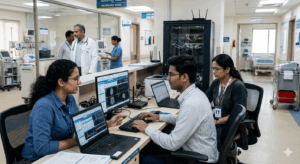
The health system is getting stronger and more robust, so is the healthcare hiring.
As for the healthcare system in India, it is in transition, with transformation underway. Doctors are consulting via screens. Patients are being monitored remotely by nurses. AI tools are also reading scans ahead of radiologists. Diagnostics are faster. Data is everywhere. In India, healthcare is no longer about beds and buildings. Medical institutions are now everywhere. It is about technology, talent, and trust. In India, there are three forces that are remaking healthcare hiring:
- Rapid digitalisation (AI, telehealth, health analytics)
- A fast-growing old-aged population
- Rising demand for specialised clinical and allied professionals
For healthcare organisations, this means one thing: traditional hiring models will no longer work. Here is your entire Healthcare Hiring Guide for 2026 – designed for Indian hospitals, diagnostic chains, healthtech startups, GCCs, and enterprise healthcare leaders.
-
What’s Driving Healthcare Hiring in India in 2026?Let’s decode the forces behind the surge.
1.1 The Digital Health Revolution
Artificial Intelligence is aiding in diagnostics. Telemedicine is mainstream. Electronic Health Records are standard. Remote patient monitoring is on the increase. Healthcare is becoming data-driven. Hospitals now need:
- AI Engineers who understand medical datasets
- Data Scientists who can grasp patient trends
- Telemedicine Developers creating virtual care platforms
- Health Informatics Specialists who administer digital records
These earlier positions were only in tech companies. Now they are key to healthcare operations. Healthcare employers are hiring not just clinicians but tech-enabled clinicians and healthcare technologists.
1.2 India’s Ageing Population
India’s senior demographic is growing at a breakneck speed. Demand for geriatric care will boom in metros and Tier-2 cities in 2026. This is driving enormous demand for:
- Geriatric Care Specialists
- Nurse Practitioners who specialise in old-age care
- Physiotherapists
- Occupational Therapists
- Home healthcare professionals
Hospitals are also spending on long-term care facilities and rehabilitation centres. That requires ongoing hiring for specialised nursing and therapy positions.
1.3 Tier-2 Cities Are Emerging as Healthcare Hubs
While metros such as Mumbai, Delhi, and Bengaluru are very strong, Tier-2 cities are rapidly building healthcare infrastructure. Cities like Indore, Coimbatore, Nagpur, Jaipur, and Lucknow are experiencing:
- Multi-speciality hospitals
- Diagnostic chains
- Medical colleges
- Telehealth centres
In these areas, demand for technicians, radiology professionals, lab specialists, and nursing staff is growing rapidly. For recruiters, this means stepping beyond metro talent pools.
High-Demand Healthcare Roles in 2026 (India Focus)
Let’s break this into three main segments.
Digital & Tech-Driven Healthcare Roles
Healthcare is deeply integrated with technology.
2.1 Data Scientists & Health Data Analysts
Hospitals produce enormous amounts of patient data. The ability to analyse it will improve outcomes and reduce costs. These professionals:
- Predict disease patterns
- Analyse readmission rates
- Optimise treatment pathways
- Improve hospital efficiency
Healthcare data talent is now a significant competitive differentiator.
2.2 AI Engineers in Healthcare
AI is used in:
- Diagnostic imaging
- Pathology analysis
- Clinical decision support
- Drug discovery
Hospitals and healthtech companies are hiring engineers who can work with both AI algorithms and medical workflows.
2.3 Telemedicine Platform Developers
Virtual care is not temporary. Developers skilled in:
- Secure video platforms
- EHR integrations
- Remote patient monitoring systems
- Data privacy compliance
are in strong demand.
2.4 Health Informatics Specialists
These professionals are at the nexus of medicine and IT. They:
- Manage electronic medical records
- Ensure interoperability
- Maintain compliance standards
- Improve patient data workflows
Hospitals are more frequently establishing in-house informatics teams.
Clinical & Specialised Healthcare Staff
Technology is growing. But human care remains central.
2.5 Nurse Practitioners
Advanced nursing roles are increasingly accepted across India. Hospitals prefer nurses who:
- Have critical care experience
- Understand digital monitoring systems
- Can operate independently
Specialisation is the key differentiator.
2.6 Geriatric Care Specialists
Elder care is now one of the fastest-growing sectors of the healthcare workforce. These professionals manage:
- Chronic diseases
- Mobility issues
- Post-surgical rehabilitation
- Palliative care
Demand is increasing in hospitals and in home-care services.
2.7 Radiologists & Imaging Specialists
Demand for diagnostics keeps soaring. AI helps, but does not substitute, radiologists. Hospitals are looking for professionals best suited to work with AI-driven imaging systems.
2.8 Mental Health Professionals
Stigma around mental health is lowering. Psychologists, psychiatrists, counsellors, and behavioural therapists are seeing increased hiring across:
- Hospitals
- Corporate wellness programs
- Schools
- Telehealth platforms
Mental health is no longer a secondary function.
Allied Health & Administrative Roles
These roles keep the healthcare system functioning.
2.9 Biomedical Engineers.
In modern hospitals, advanced devices are at capacity. Biomedical engineers:
Care for medical devices.
- Ensure device compliance.
- Take care of predictive maintenance.
- IoT knowledge and device analytics skills are highly valued.
2.10 Clinical Research Associates
(CRAs) is an ever-expanding area of clinical trials. They are desired, particularly CRAs that have certifications such as CCRP (Certified Clinical Research Professional) in their name.
- Data accuracy control.
- Ensure regulatory compliance.
- And pharmaceutical R&D expansion
is fueling strong demand as demand grows larger and larger.
2.11 Medical Coding Managers.
As insurance penetration increases, medical coding becomes increasingly vital. Hospitals need professionals who:
Understand ICD coding.
- Manage billing accuracy.
- Ensure claim compliance.
The accuracy of the computer codes greatly affects the monetary income.
Salary Outlook in India (Estimated 2026).
Here is apossible salary range:
| Role | Estimated Salary (LPA) |
| Physicians (MBBS + PG) | ₹8–30+ LPA |
| Biomedical Engineers / Data Analysts | ₹4–25+ LPA |
| Nursing Staff | ₹2.5–6 LPA |
| Allied Health Technicians | ₹2–4.5 LPA |
Specialised certifications, metro address and hospital brand all exert a powerful influence on compensation. People moving out of government services will receive a 15-25 per cent premium for the specialist skills they provide.
-
Key Hiring Trends in 2026.
Healthcare recruitment in India is
becoming more strategic.
4.1 Towards tech-enabled care.
Hospitals now evaluate applicants for:
- Digital literacy.
- Ability to work with AI tools.
- Adaptability to telehealth systems.
- Soaring demand for tech familiarity across roles.
4.2 Premiums for lateral hire:
Salary of Lateral Staff. Healthcare institutions are doing this, for example:
- Poaching from rival hospitals.
- Offering salary premiums.
- Bringing in experts from governments. Retention and hiring strategies are becoming as important as retention strategies.
4.3 AI in Talent Acquisition.
Recruiters are using AI to:
- Screen big candidate databases.
- Assess skill compatibility.
- Predict retention likelihood.
- Reduce bias
- Using data to lead hiring is no longer optional.
4.4 Rise of Home Healthcare.
More urban families prefer at-home care. Demand is rising for:
- Visiting nurses.
- Rehabilitation therapists.
- Diagnostic technicians.
- Telehealth coordinators.
Tier-2 and Tier-3 cities are demonstrating robust growth here.
-
The Key Qualifications that Matter in 2026
Here’s why healthcare employers will prioritise:
- Special certifications (e.g., CCRP).
- Familiar experiences with health IoT systems.
- Skills related to digital record management.
- Experience with AI-powered diagnostics.
- Regulatory compliance training.
Degrees are not enough. Skill alignment matters more.
-
The challenges healthcare employers experience.
Let’s be realistic. Healthcare hiring is tough.
- Specialised nursing skills shortages.
- High attrition in Tier-1 cities.
- Clinical staff burnout.
- Challenges around compliance.
- Rising salary expectations.
Hospitals must balance cost, quality, and speed.
-
How to Create a Healthcare Workforce of the Future.
Here’s what works in 2026:
- Hire for Skill Adjacency. Go above and beyond job titles. A biomedical engineer with experience in IoT would do better than a regular candidate.
- Establish Talent Pipelines in Tier-2 Cities. Costs are lower. Loyalty is more. Infrastructure is improving.
- What Technology + Human Screening = Blend AI can shortlist you. Cultural fit is established by human judgment.
- Provide Flexible Models of Engagement. Flexible contracts, project-based and full-time hiring attract all types of talent.
- Focus on Retention. Ongoing education and defined paths to growth reduce attrition.
-
Where SheWork Fits In The Medical Hiring Landscape.
Now, healthcare hiring is not transactional. It is strategic. SheWork is a diversity-first, AI-enabled appointment site that connects global corporations, GCCs, and startups with India’s best engineering, tech, and non-tech talent. With:
- 300K+ curated professionals.
- 150+ clients all over India & SEA.
- ISO 9001:2015 & 27001:2022 certified processes.
- AI-powered discovery, matching & analytics.
SheWork combines AI precision with human intelligence to make bias-free, data-driven hiring systems. The approach from engineering staffing to tech hiring and RPO/MSP solutions has a straightforward focus:
Create high-powered healthcare delivery teams that are digital-ready, compliance-strong, and culture-aligned.
When hiring needs to be 50% quicker without sacrificing quality, strategy counts.
Health Care in India by the year 2026 is not only growing, but it is also changing.
Digital systems are speeding up. Elder care is rising. Tier-2 cities are booming. Specialisation is hard work. The winners will not be people who hire faster. They will be those who hire smarter. Whether you are constructing a hospital, a healthtech firm, a diagnostic chain, or a Global Capability Centre, your recruitment strategy must keep pace. But in healthcare, talent is not just workers. It is the foundation for patient trust.